
Professional Cleaning Service Cost: Hourly Vs Fixed Rate
Whether you pay a cleaner by the hour or a fixed price per visit is one of the first decisions you face when you hire help. Each model has real trade-offs around predictability, scope and how much work actually gets done. This guide walks through both approaches so you can choose the one that fits your home, your habits and your budget.

Quick Summary
Cleaning service pricing splits into hourly, where you pay for time and risk sits with you, and fixed rate, where a set total covers an agreed scope and risk sits with the company. Home size, condition, frequency and access all affect the total, so compare the written scope behind each quote before comparing prices.
In this guide
Hourly vs Fixed-Rate Cleaning: How the Two Models Compare
Cleaning companies quote two main ways: an hourly rate or a fixed price per visit. An hourly rate means you pay for the time a team is in your home. A fixed rate means you pay a set total for a defined scope of work, however long it takes. Neither format is automatically better, and a company may offer both for different situations.
The core difference is where the risk sits. With an hourly rate, the risk of a job taking longer sits with you: if the home is messier than expected, or the cleaner finds more work than the estimate assumed, the bill can grow. With a fixed rate, that risk sits with the company: the total is agreed before the work starts, so the team carries the cost of a longer visit.
Predictability follows from that. A fixed rate gives you a number you can plan around, which is why it is popular for recurring visits. An hourly rate is more flexible when the scope changes week to week, which is why it can suit one-off jobs or a shifting priority list. The right choice depends on how much you value a known total versus the ability to adapt as the work unfolds.
Our own answer sits on the hourly side of that choice. Good Cleaner Co. quotes residential work at $52.00 an hour plus 13% HST and converts your home into hours with a published schedule, so the total is predictable before the visit even though the rate is hourly. Recurring visits reduce the service charge by 5 per cent monthly and 10 per cent every two weeks. The rate card can change, so confirm current pricing with our team before you book.

How Hourly Pricing Works (and When It Makes Sense)
An hourly rate is straightforward on the surface: you agree on a rate, and you pay for the time spent. Hourly pricing makes sense when the work is hard to predict. A first deep clean in a home that has not been properly cleaned in a while, a post-renovation reset, or a one-time job with an uncertain scope are all situations where an hourly arrangement can feel fairer for both sides. You pay for what is actually done, and the cleaner is not forced to rush through a fixed list. The trade-off is the variable bill. When the rate is hourly, the total depends on how long the visit runs, so a slower, more detailed team can cost more than a quick one even for the same rooms.
The appeal is flexibility. If one visit needs extra time in the kitchen, or you want the cleaner to focus on a particular room this week, the appointment can flex without renegotiating a whole scope.
That is not a sign of poor value by itself; thorough work takes time. The key is to understand the rate, how the time is tracked and what happens when the list is longer than the appointment.
It also helps to ask how the first hour or a minimum visit is handled. Many companies have a minimum, and travel between homes can affect the total in ways that are worth understanding before you book. A clear hourly quote names the rate, the expected time for your home and the factors that could change it, rather than leaving you to guess.
How Fixed-Rate Pricing Works (and When It Makes Sense)
A fixed rate, sometimes called a flat rate, is a set total for a defined scope of work. The company builds the price from your home's size, the number of rooms and bathrooms, and the frequency of the visits, and you agree on that number before anyone arrives. If the work takes a little longer than expected, the total does not change. Fixed-rate pricing shines for recurring visits. A weekly or bi-weekly clean with a consistent scope is easy to price up front, easy to budget for and easy to compare across providers because the same work is quoted the same way each time.
Many households prefer this model for exactly that reason: the number on the calendar is the number on the bill.
The trade-off is that the scope has to be well defined for a flat rate to be fair. If the quoted list is vague, one company's flat rate may include work another company treats as an add-on, which is how a low headline price turns into a higher reality. Read the quote as a scope of work: the rooms, the tasks, the exclusions and anything that is extra.
A fixed rate also has a natural ceiling. If your home changes shape — a renovation, a move, a change in pets or household size — the flat rate should be revisited rather than silently stretched. A good company will tell you when the scope has moved far enough that the price needs to change, and it will explain that clearly before the visit.
What Actually Affects the Cost of a Clean
Whatever the pricing model, the same set of factors drives the total. Home size and the number of rooms and bathrooms carry most of the weight, because they set the floor area and the surface area a team has to cover. A compact condo and a family home with the same square footage can still differ a lot in how much work they need. The condition of the home matters almost as much as its size. A home that is maintained with regular visits needs less time than one that has accumulated months of build-up, and the difference shows up in the quote. Frequency changes the shape of the job too: weekly maintenance is usually lighter than a monthly reset, which is why a monthly visit can cost more per visit even as it costs less overall.
Practical details often surprise first-time clients. Access and parking, a long drive, a walk-up, a security desk or building booking rules all add coordination that a quote may reflect. Whether supplies and equipment are included, whether there are pets to work around, and whether the job needs special products for stone, hardwood or delicate surfaces can all move the number. Asking about these up front is how you get a quote you can trust rather than a baseline you have to decode. For carpets specifically, our carpet cleaning DIY vs professional comparison covers when a DIY approach can make sense instead.
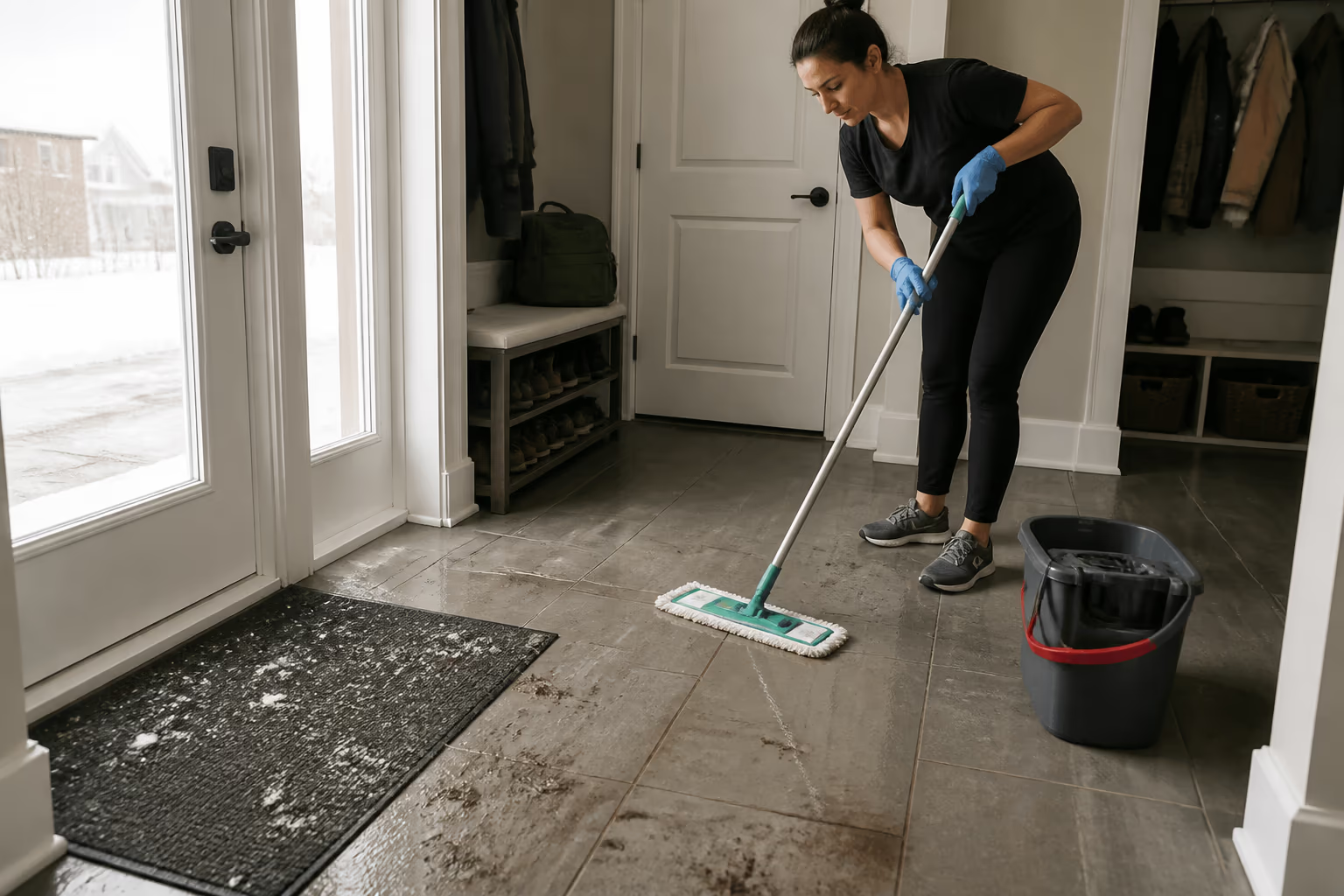
Ottawa's seasons add another layer. Winter brings salt, sand and grit through the door, so entryways, mudrooms and floors near exterior doors can need more time between visits. Spring often reveals dust and grit that built up over months of closed windows, and it is a natural moment for a deeper reset. A quote that flexes with the season is a sign that the company understands how local homes actually live.
Typical Ranges, and Why No Single Price Is Universal
It is tempting to want a single number, but professional cleaning prices in Canada vary from market to market, and no fixed figure applies to every home. A rate that is reasonable in one neighbourhood can be out of line in another, and a scope that is a standard visit for one company may be an add-on for the next. The honest answer to how much a clean costs is that it depends on the work, and the useful version of that answer is a written quote. Our page on typical Ottawa cleaning price ranges is a useful reference point before you request quotes.
One figure is fixed and public. Ontario's general minimum wage is $17.60 an hour from 1 October 2025 to 30 September 2026, and the Government of Ontario has set it to rise to $17.95 on 1 October 2026. An hourly cleaning rate has to clear that floor first, then cover payroll costs, supplies, equipment, travel and supervision before anything is left over. That is why a quoted rate sitting close to minimum wage rarely describes a fully employed, trained and supervised team. The provincial guide defines it in one sentence: “Minimum wage is the lowest wage rate an employer can pay an employee.”
When you see a quoted range, treat it as a starting point, not a guarantee. Ranges reflect the kinds of homes and scopes a company serves, but your home is specific: its layout, its condition, its access and the tasks you need. A quote built for your exact situation will always be more meaningful than a range published in an advertisement.
The same caution applies to comparisons. Two providers can quote the same total for very different amounts of work, or very different totals for the same work. Before you compare numbers, compare the scopes behind them. That is the difference between shopping on price and shopping on value, and it is the habit that prevents most pricing surprises.
If a price seems unusually low, it is worth understanding why. Sometimes a low quote reflects an efficient, well-organised team. It can also reflect a thinner scope, an unrealistic time allowance, or costs that were simply never counted. You do not need to solve a company's finances to be a careful customer; you only need to notice when the promised work and the quoted amount do not seem to belong together.
Asking the Right Questions Before You Book
Good questions turn a vague estimate into a useful one. Ask whether the price is hourly or fixed, what exactly is included, what is excluded, and what happens if the visit takes longer or the scope changes mid-job. Ask how supplies, travel and a first deep clean are handled, and confirm whether the first appointment is priced differently from recurring visits.
Ask about the team as well as the price. Who will be doing the work, are they background-checked and trained, and how does the company handle the occasion when a home is not left to standard? These are not difficult questions; they are the ordinary ones that tell you whether a company can be relied on over time, and they belong in any conversation before you hand over keys or a code.
Good Cleaner Co. quotes home cleaning on a clear, written scope rather than a number pulled from the air. For a regular visit, a fixed price built from your home's size and rooms gives you a predictable total. When a one-off job has an uncertain scope, the company can work hourly and explain the factors that would move the total. Either way, you should know what you are paying for before the work begins.
If you are comparing providers, our commercial cleaning company vetting guide is a useful starting point for the questions that matter. Businesses weighing the best office cleaning service in Ottawa face the same hourly-versus-fixed decision. The same discipline applies to a single home as to a whole building: ask who does the work, what the scope covers, how quality is checked and how changes are handled, then compare the scopes before you compare the totals.

Formatted Step-by-Step Checklist for Comparing Pricing Models
Use this checklist the next time you request a cleaning quote. It is designed to help you compare the work, not just the number.
- Step 1.Decide which pricing model fits you:a fixed rate for a predictable recurring visit, or an hourly rate for flexible, harder-to-predict work.
- Step 2.Ask for a written scope that names the rooms, the tasks, the exclusions and the frequency before you ask for a total.
- Step 3.Confirm what moves the price, including condition, access, parking, travel, supplies, pets and a first deep clean.
- Step 4.Compare the scopes behind two or more quotes first, then compare the totals, so you are comparing like with like.
- Step 5.Revisit the arrangement whenever your home changes shape, whether that is a renovation, a move or a change in household size.
- Step 6.If you would like a trained team with a clear written scope, our trusted home cleaning crews in Ottawa are a practical place to start.
Free Deep Clean Checklist to Print
The gap between a regular visit and a deep clean is a list of tasks, not a feeling. This printable sheet sets out what the deeper pass adds, room by room, in the order a professional works.
Mark the lines your home needs before you ask for a quote. There is no form and no email address to hand over.
Letter size, print-ready. No email address, no sign-up.
FAQ
Is an hourly rate or a fixed rate cheaper?
Neither format is automatically cheaper. A fixed rate is usually more predictable, and an hourly rate is usually more flexible. The better value depends on your home, the scope and the condition it is in, so compare the work behind each quote rather than the format.
What happens if the cleaning takes longer than the fixed rate assumed?
With a fixed rate, the agreed total stands regardless of how long the visit runs, because the risk of a longer job sits with the company. The important part is that the scope is defined before the work starts, so both sides know what the total covers.
Why do some companies charge more for a first visit?
A first visit often includes accumulated build-up and time spent learning the home. It is not automatically a hidden charge, but it should be described separately from the recurring schedule so you can decide whether the reset is worthwhile.
Do I pay more if the cleaner uses their own supplies?
That depends on the company and the quote. Some include supplies and equipment in the price; others charge for them separately. Confirm it in writing before you book, especially if you need a particular product for a surface.
How is the time tracked for an hourly cleaning job?
Ask before the visit. Many companies track by the actual time the team is in the home, and some apply a minimum visit. A clear hourly quote names the rate, the expected time for your home and the factors that could change it.
Can a fixed-rate plan save money over time?
It can make each visit more predictable because the scope stays consistent, and consistent maintenance usually means lighter work than occasional resets. Whether it saves you money depends on the quoted scope, the frequency and the condition of the home.
Why do quotes for the same size of home differ so much?
Because price reflects more than square footage. Condition, layout, access, pets, frequency and the level of detail in the scope all affect the total, and different companies draw the lines differently. Compare the scopes to understand why the numbers differ.
Should I tip a professional cleaner?
Tipping is optional and not required. Some clients choose to tip for exceptional work or around the holidays, but it is never expected, and it should not affect the quality of the service. If you are unsure, ask the company about its own guidance.
Is the price on the website the price I will actually pay?
The price on a website is usually a starting point for a typical home. Your exact total depends on the written scope for your specific space, including its condition, access and any extras. Ask for a quote built around your home before you book, and read the scope alongside the number.
Which is better value, an hourly rate or a flat rate?
Neither by itself. An hourly rate is honest about time and flexes with the home; a flat rate is easier to budget but hides how long the visit will be. What decides value is whether the scope beside the number matches what you want done.
How do I compare an hourly quote with a flat quote?
Ask the hourly provider how many hours your home takes, and ask the flat-rate provider what the visit includes and what happens when it runs long. Once both answers exist, the two numbers describe the same work and can be compared.
What happens if the job takes longer than expected?
With time-based pricing the visit is quoted from a published schedule, so the hours are agreed before the clean starts rather than discovered at the end. Anything outside the agreed scope is a conversation, not a surprise on the invoice.
Wrapping Up
The choice between an hourly rate and a fixed rate comes down to what you value: a known total for a defined scope, or flexibility when the work is harder to predict. Neither is universally better, and the pricing model matters far less than a clear, written scope and a company you can trust to follow it. Contact Good Cleaner Co. for a quote that explains exactly what you are paying for, and why.
Keep reading
More from Good Cleaner
Services that fit
- House Cleaning Services in OttawaHouse cleaning services in Ottawa for one-time, weekly, biweekly, and monthly home care, with customizable cleaning and eco-friendly options.
- Janitorial Services in OttawaRecurring janitorial services in Ottawa for offices, warehouses, retail, dealerships and schools, with eco-friendly commercial cleaning, customized plans and a free quote.
About the author
Service areas
- Ottawa
- Kanata
- Nepean
- Orleans
- Barrhaven