
Building Cleaning Standards in Canada: Compliance & Quality Protocols
Property managers and building owners across Ottawa are responsible for keeping commercial facilities clean, safe, and compliant with Canadian standards. The challenge is that there are several different benchmarks to track, from APPA cleanliness levels to Health Canada disinfectant rules. This guide breaks down each one in plain language and explains how a professional team documents compliance, so you know what to look for and what to ask. It also covers the seasonal and environmental factors that make Canadian buildings different from facilities in milder climates.
Quick Summary
Canadian commercial buildings are expected to meet measurable cleaning standards, and the most important ones are simpler than they sound. This guide explains APPA cleanliness levels, CIMS certification, Health Canada DIN disinfectants, and WHMIS 2015 safety, and how a cleaning partner documents them.
In this guide
National Benchmarks for Commercial Facility Hygiene in Canada
Canadian commercial cleaning is guided by recognized national benchmarks rather than a single federal regulation. The two most common are APPA cleanliness levels and the ISSA CIMS standard.
APPA, the association that represents higher-education facilities, defined a five-level cleanliness scale that has become the de facto language for describing how clean a building should be. Facility managers and cleaning companies use it to agree on a target level, inspect against it, and prove that the standard was met.
ISSA CIMS, the Cleaning Industry Management Standard, is a certification for cleaning organizations themselves. It verifies that a company has formal systems for quality control, service delivery, and safety, rather than just promising good work. For a building owner, hiring a CIMS-certified contractor is a strong signal of professionalism.
Regulatory Frameworks: Health Canada DIN, WHMIS 2015 & EcoLogo
Cleaning products sold and used in Canada sit within a few clear regulatory frameworks. Knowing them helps you understand what your cleaning team is actually using.
- 1Health Canada DIN Registration
Hard surface disinfectants that make germ-killing claims must carry an 8-digit Drug Identification Number issued by Health Canada. The DIN means the claim has been verified with laboratory evidence.
- 2WHMIS 2015 GHS Workplace Safety
Commercial cleaning chemicals carry standardized hazard labels and digital Safety Data Sheets, and workers must be trained to handle them safely.
- 3APPA Level 2 (Orderly Spotless) Hygiene
Most professional office buildings target the higher APPA levels for lobbies, washrooms, and high-traffic areas.
- 4
Reviewing our DIY citrus all-purpose cleaner guide offers compliant surface maintenance tips for teams that want to supplement their routine cleaning with simple, low-chemical options.
One of those frameworks has three concrete requirements. Ontario's WHMIS legislation requires hazardous-product information to be delivered by labels on the containers, safety data sheets, and worker education programs, and it classifies hazardous products into physical and health hazard groups. The province states the employer duty: “Employers must pass the information about workplace hazardous products on to their employees and provide worker education programs.”
Understanding APPA Cleanliness Levels
The APPA scale runs from Level 1, which is the spotless standard you would expect in a newly finished building, down to Level 5, which indicates serious neglect. Most professional facilities target Level 1 or Level 2 for public and high-traffic spaces.
At Level 1, surfaces are free of dust, spots, and marks, and the building feels freshly finished. At Level 2, the building is still immaculate in appearance, with only minor issues that are addressed quickly. Lower levels allow for increasing amounts of visible dust and soil, which is why a reputable janitorial contract is written around a specific target level.
The useful part of the APPA scale is that it gives both sides a way to inspect objectively. Instead of arguing over whether a lobby looks clean enough, a building owner and a cleaning company can walk through with the same checklist and agree on the observed level.
In practice, most contracts are written with a baseline of Level 2 for general office areas and Level 1 for high-profile spaces like reception, washrooms, and meeting rooms. The schedule is then built to hold that level: daily dusting and surface care, frequent washroom servicing, and periodic deep cleaning of carpets and hard floors. The inspection log becomes the proof that the agreed level was maintained over the term of the contract.
What CIMS Certification Really Means for Your Building
CIMS certification is awarded to cleaning organizations that demonstrate consistent, documented management systems. It covers quality control, service delivery, human resources, and regulatory compliance, and it is verified by an independent third party.
For a building owner, the practical benefit is accountability. A CIMS-certified company has written procedures for everything from staff training to inspection checklists, which means the quality you see on the first visit is the quality you can expect every night. Certification also requires ongoing audits, so the company cannot simply let its standards slip after winning the contract.
It is worth asking any prospective cleaning partner whether they hold CIMS certification and asking to see their inspection and quality-control documentation. A company that can show you the paperwork is far more likely to meet the standard on the ground.
Certification is not a one-time event either. CIMS requires the organization to maintain its systems and re-verify them, which means the discipline does not fade a year into a contract. For a building owner, that is the reassurance you are paying for: the quality control is baked into how the company operates, not dependent on the mood of a single supervisor.
Indoor Air Quality & Green Cleaning in Canadian Buildings
Cleaning has a direct effect on indoor air quality, and Canadian building standards increasingly treat that as a priority. Low-VOC and EcoLogo-certified products reduce the chemical load released into the air, which matters in occupied offices where people spend eight hours a day.
HEPA filtration is the other half of the equation. Sealed HEPA vacuums trap fine particles, including allergens and dust, instead of blowing them back into the room. For buildings that house people with allergies or asthma, this is not a luxury; it is part of a responsible cleaning program.
Green cleaning is not a single product but a system: certified chemistry, proper dilution, colour-coded microfibre cloths to prevent cross-contamination, and documented procedures. When a janitorial company can explain that system, you know the indoor air quality program is real rather than a label on a bottle.
It is also worth understanding that green chemistry has improved significantly. Modern low-VOC concentrates clean as well as conventional products in most everyday commercial situations, so a building does not have to choose between sustainability and a visibly clean space. The right program delivers both, and it tends to cost less over time because concentrated products and microfibre systems reduce both chemical use and waste.
The Difference Between Cleaning, Sanitizing & Disinfecting
These three words are used interchangeably, but they describe very different levels of treatment, and Canadian compliance depends on using the right one in the right place.
Cleaning removes visible soil, dust, and grease from a surface using water and detergent. It does not necessarily kill germs, but it removes the organic material they need to survive, which is why cleaning always comes first.
Sanitizing reduces the number of germs on a surface to a safe level, as defined by the product label. It is appropriate for food-contact surfaces and general touchpoints where you want to lower the germ load quickly.
Disinfecting kills a higher percentage of germs on hard surfaces and is what washrooms, high-touch areas, and healthcare settings require. In Canada, a product that claims to disinfect must carry a Health Canada DIN, because that claim has to be backed by evidence.
A compliant janitorial program uses all three in the right order: clean the surface, sanitize where the risk is moderate, and disinfect where the risk is highest. Skipping the cleaning step is the most common mistake, because disinfectant applied over dirt cannot reach the surface it is supposed to protect. The label on every Canadian disinfectant also tells you the contact time, and a professional crew follows that timing rather than wiping the product off immediately.
Formatted Step-by-Step Canadian Cleaning Compliance Checklist
Follow this checklist to confirm your commercial facility meets Canadian standards:
- Step 1.Verify Health Canada DIN Registration on All Surface Disinfectants:Check that every disinfectant making germ-killing claims carries a valid 8-digit DIN.
- Step 2.Audit WHMIS 2015 Safety Data Sheets in Custodial Closets:Confirm digital and physical SDS records are current and accessible to every worker.
- Step 3.Implement Colour-Coded Microfibre Cloth Systems:Use separate cloths for washrooms, kitchens, and workstations to eliminate cross-contamination.
- Step 4.Calibrate Floor Equipment to Canadian Electrical & Safety Standards:Ensure auto-scrubbers and vacuums meet Canadian certification and are maintained on schedule.
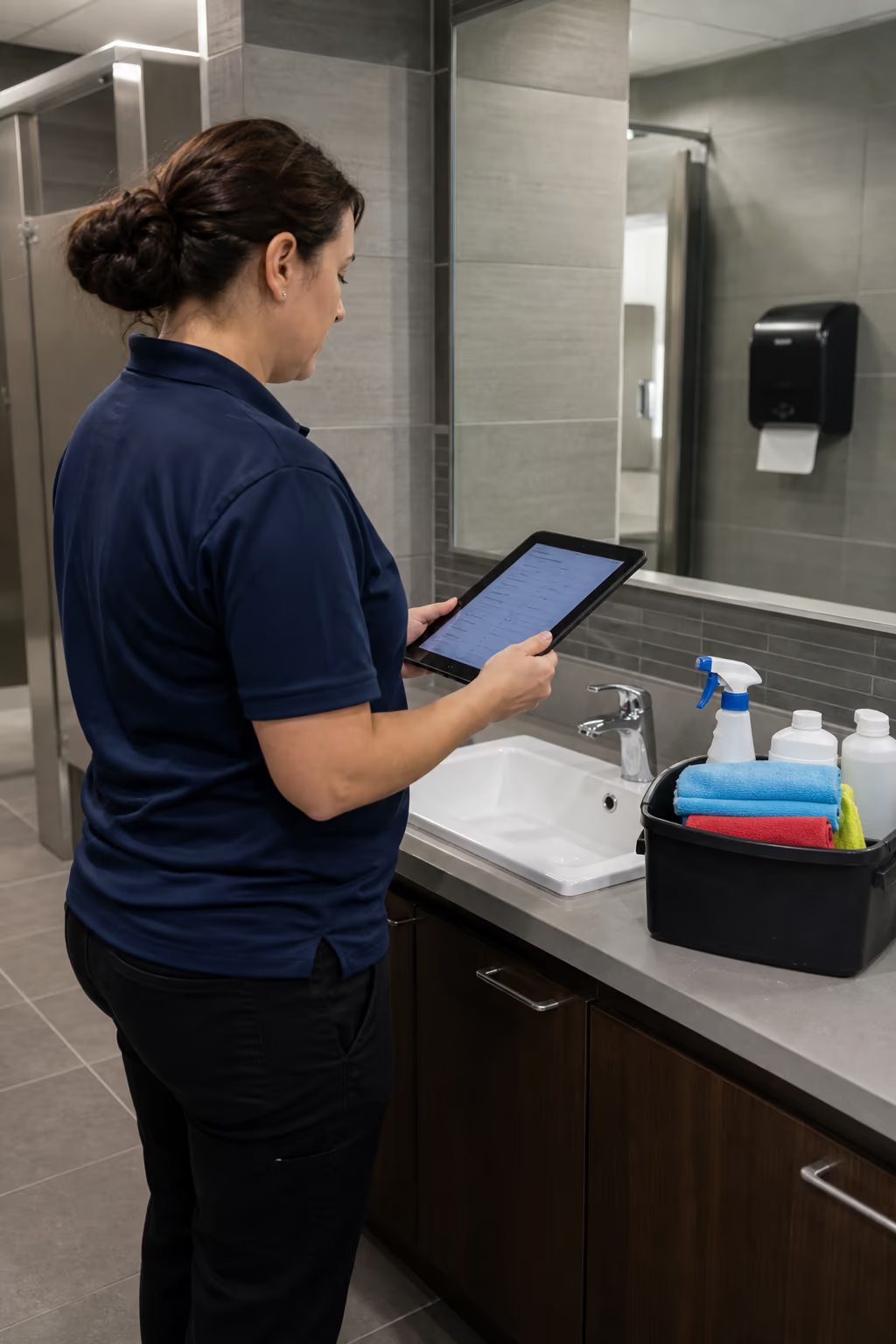
- Step 5.Conduct Bi-Weekly APPA Level Quality Audits with Timestamped Inspection Software:Inspect against a written target level and keep records you can share with the building owner.
- Step 6.Contracting professional commercial janitorial services in Ottawa through Good Cleaner Co. guarantees full Canadian compliance with documented quality control.
Serving Commercial Buildings Across Ottawa
Good Cleaner Co. provides compliant janitorial care for commercial buildings across Ottawa, from the technology campuses in Kanata to office towers downtown and medical and retail spaces in Nepean, Barrhaven, and Orleans. We serve multi-tenant offices, clinics, schools, and light-industrial spaces, and we tailor the scope to the building rather than applying a one-size-fits-all routine.
Good Cleaner Co. Professional Service Introductions & Specializations
Good Cleaner Co. is a local cleaning company serving Ottawa homes and businesses, and we keep the same careful standards across everything we do. Here is what we offer:
Seasonal Maintenance & Local Environmental Factors in Ontario
Property maintenance in Ottawa means adapting your cleaning routine to real seasonal shifts:
Quality Assurance & Health Canada Disinfection Compliance
Homes and businesses in Ontario work within a clear set of safety and health rules:
FAQ
What are APPA cleanliness levels and how do they apply to commercial buildings in Canada?
APPA defines a five-level cleanliness scale from Level 1, which is spotless, down to Level 5, which indicates neglect. Professional buildings typically target Level 1 or Level 2 for lobbies, washrooms, and high-traffic areas.
Why is Health Canada DIN registration required for commercial disinfectants in Ontario?
An 8-digit DIN means Health Canada has evaluated laboratory evidence proving the disinfectant kills the germs its label claims, so you are not relying on an unverified marketing promise.
What WHMIS 2015 safety requirements must commercial cleaners follow in Ottawa?
Cleaners must be trained to read GHS hazard symbols, have current Safety Data Sheets available, and wear the required personal protective equipment for the products they handle.
What is the ISSA Cleaning Industry Management Standard (CIMS)?
CIMS is a third-party certification that verifies a cleaning organization follows documented systems for quality control, service delivery, safety, and staff training.
How do Canadian building cleaning standards address indoor air quality?
Standards favour sealed HEPA vacuuming and low-VOC EcoLogo chemistry, which reduce airborne dust and chemicals in occupied spaces.
How do janitorial crews meet Canadian winter floor safety standards?
Crews use pH-neutral rinses that dissolve tracked-in salt and place heavy-duty entry matting to reduce slip-and-fall hazards in entryways.
Are commercial cleaning companies in Ottawa required to carry WSIB registration?
Yes. Active WSIB coverage protects the building owner from liability if a cleaning worker is injured on the job.
How does Good Cleaner Co. document compliance with Canadian building standards?
Good Cleaner Co. provides digital inspection logs, SDS documentation, and WSIB clearance as part of the service record.
How often should a commercial building be deep cleaned to maintain APPA standards?
High-traffic areas should be cleaned daily, with deep cleaning of carpets, vents, and hard-to-reach surfaces scheduled seasonally or as needed to hold the target level.
What should a building owner ask a cleaning company before signing a contract?
Ask for CIMS certification, WHMIS training records, a list of the chemicals used with their SDS, and a written inspection process tied to a specific APPA level.
How often should high-touch surfaces be disinfected in a commercial building?
High-touch points like door handles, elevator buttons, light switches, and washroom fixtures should be disinfected at least daily, and more often in healthcare or high-traffic settings.
Do Canadian building standards require a specific cleaning frequency?
There is no single national frequency requirement. Standards define the target cleanliness level, and the schedule is designed to hold that level, which varies by building type, traffic, and use.
Wrapping Up
A useful building-cleaning standard turns expectations into a routine that can be checked. List the areas, frequencies, approved products, access constraints, and the person responsible for signing off. Keep the document current when occupancy, building use, or local requirements change, and use the applicable official or property-management guidance for any regulated question. A checklist is not a substitute for legal, health, or safety advice, but it can prevent inconsistent work and unclear handoffs. The goal is a transparent standard that staff, contractors, and occupants can understand before a problem becomes a complaint.
Keep reading
More from Good Cleaner
About the author
Service areas
- Ottawa
- Kanata
- Nepean
- Barrhaven
- Orleans