
Commercial Cleaning ROI: Financial & Productivity ROI Investment Guide
Commercial property owners and business leaders in Ottawa often treat janitorial services as a cost to minimize. The more useful view is to ask what the money buys, because a professionally maintained facility protects expensive assets, keeps your team healthier and more productive, and projects an image that wins and keeps clients.

Quick Summary
Commercial cleaning often looks like a monthly expense line, but it is really an investment with returns you can measure. This guide explains how professional janitorial care preserves your flooring, protects payroll from avoidable sick days, lowers in-house overhead, and strengthens the impression your building makes on clients, with a practical checklist for estimating your own return.
In this guide
Calculating the True Financial Return of Professional Facility Hygiene
The honest starting point is that a clean building pays for itself in several quieter ways that never appear on a cleaning invoice.
The most direct return is asset protection. Office flooring, carpet, washroom fixtures, and HVAC systems represent a large share of a building's value, and they wear out faster when they are not maintained. Salt and grit from Ontario winters grind into entryways, coffee spills work their way into carpet fibres, and dust slowly chokes air filters. Professional cleaning removes those threats on a schedule, so the building's finishes last years longer before they need expensive replacement.
The second return is on people. A cleaner workplace is associated with fewer avoidable sick days, which matters because payroll is usually the largest single line in a business budget. When surfaces are wiped down and washrooms are sanitized on a regular schedule, the common-touch points that pass germs around the office get attention before they become a problem.
The third return is on perception. Clients, candidates, and inspectors form an impression of a business in the first minutes they spend in its space. A spotless lobby, tidy washroom, and polished boardroom quietly tell visitors that the company cares about details, and that impression supports sales conversations and staff pride.

How Professional Cleaning Protects Your Physical Assets
Flooring is usually the biggest asset a cleaning program protects, and it is also the one most visibly damaged by neglect.
Commercial floors face a constant assault. In winter, calcium chloride and rock salt get tracked into foyers and entryways, where the abrasive slurry scratches hardwood polyurethane, leaves white rings on carpet, and etches natural stone. In summer, tracked-in grit and spills sit on the surface and grind underfoot. Daily dust mopping, damp mopping with pH-neutral chemistry, and periodic machine scrubbing remove that abrasive layer before it damages the finish.
Carpet deserves its own mention. Professional hot water extraction lifts the soil that vacuuming cannot reach, removes the salt slurry that winter tracking leaves behind, and extends the life of an expensive floor covering that would otherwise need replacement years early.
Washroom fixtures and hardware also benefit from regular care. Mineral deposits, soap scum, and hard water stains are far easier to remove weekly than to grind away after months of build-up, and well-maintained fixtures simply look better to everyone who uses them.
The Payroll Side: Sick Days, Productivity, and Staff Morale
For most businesses, the people are worth more than the building, which is why the payroll return on cleaning deserves careful attention.
Offices are shared environments. Door handles, taps, kitchen counters, elevator buttons, and shared desks pass germs from one person to the next, and the peak of cold and flu season lines up exactly with the winter months when buildings are sealed up and recirculating air. A cleaning program that sanitizes high-touch points on a regular schedule reduces the surface transmission that drives avoidable sick days. A commercial cleaning frequency guide can help you match that regular schedule to how heavily each zone in your building is actually used.
Fewer sick days matter twice. The direct cost is the wages paid for time away, and the indirect cost is the productivity lost when a team member is out, work shifts onto colleagues, and momentum slows. Over the course of a year, those small absences add up to a meaningful number for a small team.
There is a morale angle too. People notice when their workplace is cared for. A clean kitchen, a tidy washroom, and a desk area that gets regular attention signal that the employer respects the people who work there, and that feeling shows up in how staff talk about the place.
Many businesses assume in-house cleaning is cheaper because they can direct an employee to wipe down the office. The comparison is rarely that simple.
The comparison starts from a fixed number. Ontario's general minimum wage is $17.60 an hour from 1 October 2025 to 30 September 2026, rising to $17.95 on 1 October 2026, whether the cleaner is on your payroll or a contractor's. The provincial guide is broad about who it covers: “Most employees are eligible for minimum wage, whether they are full-time, part-time, casual employees, or are paid an hourly rate, commission, piece rate, flat rate or salary.”
When you clean in-house, you pay for more than the cleaning. There is the payroll itself, plus the taxes and benefits that come with any employee. There is the equipment, from vacuums and floor machines to microfibre supplies and cleaning chemistry. There is the management time spent supervising quality, ordering supplies, and covering for sick days or holidays. And there is the reality that most staff are not trained professional cleaners, so results are inconsistent and high-risk tasks like washroom sanitation get rushed.
A professional commercial cleaning contractor spreads those costs across many clients. They bring trained staff, commercial-grade equipment, and a documented quality program, and they supply the chemistry and consumables as part of the contract. For most businesses, outsourcing delivers a higher and more consistent standard for a predictable monthly cost, and it frees your team to spend their hours on the work they were hired to do. Comparing current commercial cleaning pricing in Ottawa against your in-house overhead is a useful first step before running the full ROI calculation.
For facilities that want to stretch their maintenance budget, reviewing our citrus cleaning spray recipe offers an economical option for light spot cleaning between professional visits.
Client Presentation and Brand Equity
A building makes a statement before a word is spoken. The condition of the lobby, the washroom, and the meeting rooms shapes how clients judge your business.
Think about what happens when a potential client arrives for a first meeting. They park, walk through the entry, pass the reception desk, and use the washroom, and every surface they touch forms part of their impression. A scuffed lobby floor and a tired washroom whisper that the company cuts corners. A bright, clean, well-scented space says the opposite, and that impression supports the conversation you are about to have.
The same logic applies to retention. Existing clients and tenants notice when standards slip, and they compare what they experience against what competitors offer. Maintaining a consistently clean facility is one of the quieter ways to protect the relationships and contracts you already have. A commercial cleaning guide for property managers goes deeper into how retention and first impressions factor into a facility budget.
How to Estimate Your Own Cleaning ROI
You do not need a finance degree to put rough numbers on the return from professional cleaning. A simple framework gets you most of the way.
Start with asset protection. Estimate the replacement cost of your flooring and carpet, divide by the expected lifespan, and then ask how much longer regular maintenance would realistically keep those assets in service. Even a modest extension of life represents real money that you would otherwise spend on premature replacement.
Next, look at payroll. Count the sick days your team took last year, multiply by the average daily cost of an employee, and consider what share of those absences a cleaner workplace might reasonably prevent. You do not need a precise figure; a conservative estimate is enough to show the direction.
Add the overhead you would avoid by outsourcing. Equipment, supplies, management time, and the hidden cost of inconsistent results all disappear from your plate when a contractor takes over.
Finally, weigh the revenue side. A strong first impression supports sales conversations and client retention, and while that is hard to measure exactly, it is real. When you add the four pieces together, the monthly cleaning invoice usually looks very different.

Formatted Step-by-Step Commercial Cleaning ROI Audit Checklist
Follow this checklist to evaluate your facility's janitorial return on investment:
- Step 1.Estimate Flooring and Carpet Replacement Costs:Put a number on what your floors are worth and how long they should last with proper maintenance.
- Step 2.Review Last Year's Sick Leave and Absenteeism Costs:Count the days and multiply by the daily cost of each role to see what a healthier workplace is worth.
- Step 3.Add Up Your Current In-House Cleaning Overhead:Include equipment, supplies, management time, and the hidden cost of inconsistent results.
- Step 4.Consider the Client Presentation Value:Ask how much a strong first impression supports your sales conversations and tenant retention.
- Step 5.Compare All-Inclusive Contract Pricing Against That Total:Measure the professional contract against the full cost of doing it yourself, not just the sticker price.
- Step 6.If you need a team or a recurring schedule, use commercial janitorial services in Ottawa to discuss scope, access, and timing before deciding whether it fits.
Serving Ottawa's Business Neighbourhoods
The same return on investment logic applies whether your space is a Kanata tech office, a Nepean clinic, an Orleans retail location, or a downtown corporate suite. Good Cleaner Co. brings the same professional standard across the capital region, so a multi-site business gets consistent results everywhere instead of a patchwork of local arrangements.
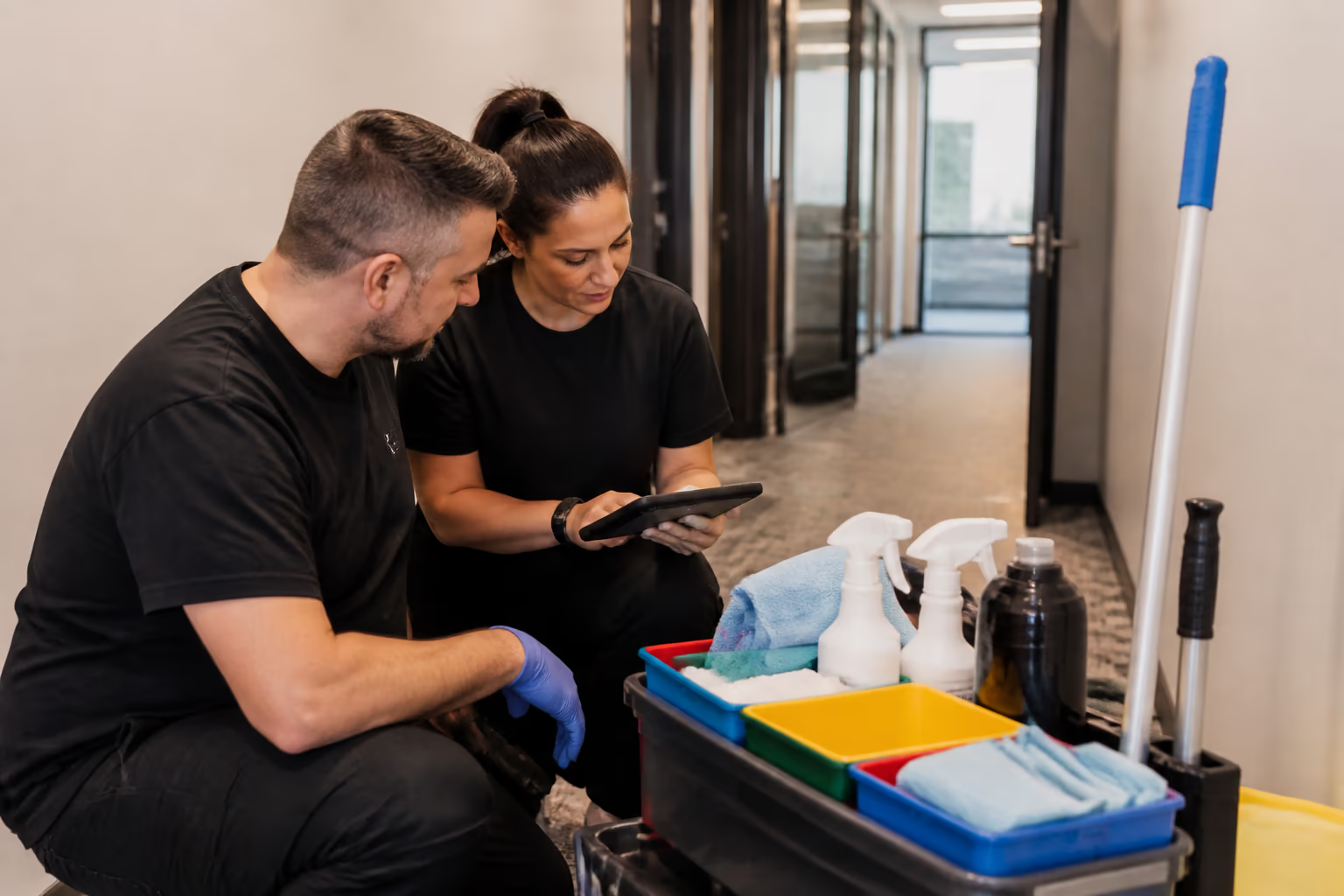
Practical planning for this situation
For a decision-maker, the sensible starting point is assessing the value of commercial cleaning. Begin with a walk-through and write down the scope, building condition, operating interruption, risks, and measures the business can actually observe. That gives the work a real boundary and avoids treating a generic package as if it already understood the space.
Use the written notes to decide what belongs in a regular routine and what needs separate time, access, or approval. The useful test is whether another person could read the scope and understand the task without being told to rely on a promise.
Seasonal considerations in Ottawa
Local conditions matter, but they do not require a script. In this topic, seasonal entrance work and occasional resets should be named separately from a regular service plan. Review the condition of the actual space before changing the products, equipment, or frequency.
A short seasonal review is usually enough: notice what has changed, name the affected area, and agree on the practical response. That keeps maintenance connected to the property rather than a broad list of place names.
Safe, responsible cleaning
Choose methods that suit the material and follow the product or equipment instructions. Keep people away from a wet or actively cleaned area, and stop when a surface reacts unexpectedly.
When a task involves an unfamiliar finish, access issue, or safety concern, ask before continuing. A careful pause is more useful than a confident shortcut and protects the people using the space.
How to review the routine
Before changing the routine, take a few minutes to describe the present condition in plain language. Start with the scope, building condition, operating interruption, risks, and measures the business can actually observe. This makes it possible to decide what is necessary without inflating a small issue into a large project.
Ask the people who use the space what causes the most friction. Their answer may be a difficult entry, a storage gap, a time when work cannot happen, or a surface that needs a gentler method. Those details are the basis for a useful plan.
Try one visible adjustment at a time. Record why it was made, what area it affects, and what a satisfactory result looks like. That approach is easier to review than changing a whole routine at once.
Keep feedback specific: name the room, surface, timing, and expected result. Clear notes help a household, volunteer group, or service team work through a problem without blame or vague expectations.
Revisit the plan after a genuine change in use, condition, or season. A routine should be steady enough to follow and flexible enough to stay useful.

FAQ
How does professional commercial cleaning preserve building floor assets in Ottawa?
Daily dust mopping and pH-neutral damp mopping remove the abrasive salt and grit that scratch polyurethane seals and damage tile glazes. Regular machine scrubbing and periodic refinishing then keep the finish in service years longer than an unmaintained floor.
What is the payback period for outsourcing office cleaning in Ontario?
Most businesses find that preserved flooring, fewer avoidable sick days, lower in-house overhead, and stronger client presentation add up to a full return within the first year or two. The exact timing depends on the size of the facility and the cost of the contract.
How does clean office air reduce commercial building utility bills?
HEPA vacuuming removes airborne dust before it clogs HVAC filters, so filters stay cleaner, airflow stays stronger, and heating and cooling equipment works less hard. Cleaner filters also mean less frequent replacement.
Is it really cheaper to outsource cleaning instead of doing it in-house?
For most businesses, yes, once you count payroll taxes and benefits, equipment and supplies, management time, and the cost of inconsistent results. A contractor spreads those costs across many clients and delivers a higher standard for a predictable monthly fee.
What cleaning tasks have the biggest impact on employee health?
High-touch points make the biggest difference: door handles, taps, light switches, kitchen counters, elevator buttons, and shared desks. Sanitizing those surfaces on a regular schedule reduces the germ transfer that drives avoidable sick days.
How does cleaning protect office carpet from premature replacement?
Professional hot water extraction removes the deep-set soil and winter salt slurry that vacuuming leaves behind. That lifts the abrasive grit that wears down carpet fibres, so the carpet stays fresh and lasts years longer.
Can a small business still get a good return from professional cleaning?
Yes. Small teams feel sick days and client impressions even more acutely, because every person and every visit matters. A modest cleaning schedule focused on washrooms, kitchen, and high-touch points protects the assets and people a small business can least afford to lose.
How do I measure whether my cleaning contractor is actually delivering value?
Ask for documented quality reports with scores and photos, review the condition of high-touch zones yourself, and keep a simple tally of tenant or staff complaints. If the building stays consistently clean and complaints stay low, the contract is earning its keep.
Does investing in green cleaning change the financial picture?
EcoLogo-certified chemistry and modern microfibre systems tend to use less chemical and water over time, which trims consumable costs while keeping the workplace safer. The asset protection and presentation returns apply exactly the same.
How does Good Cleaner Co. help clients understand their cleaning investment?
Good Cleaner Co. provides clear all-inclusive pricing, documented quality reports, and an account manager who can help you line up the cost of the contract against the asset and payroll savings it protects.
Wrapping Up
Commercial cleaning is easiest to justify when it is measured against what it prevents: sick days, premature wear on floors and fixtures, and the impression a tired-looking space leaves on the people who walk through it.
Keep reading
More from Good Cleaner
Services that fit
- Janitorial Services in OttawaRecurring janitorial services in Ottawa for offices, warehouses, retail, dealerships and schools, with customized plans and eco-friendly chemistry.
- Professional Office Cleaning Services in OttawaNightly and after-hours office cleaning for corporate offices, clinics and professional suites, with after-hours scheduling and eco-friendly products.
About the author
Service areas
- Ottawa
- Downtown Ottawa
- Kanata
- Nepean
- Orleans
- Barrhaven